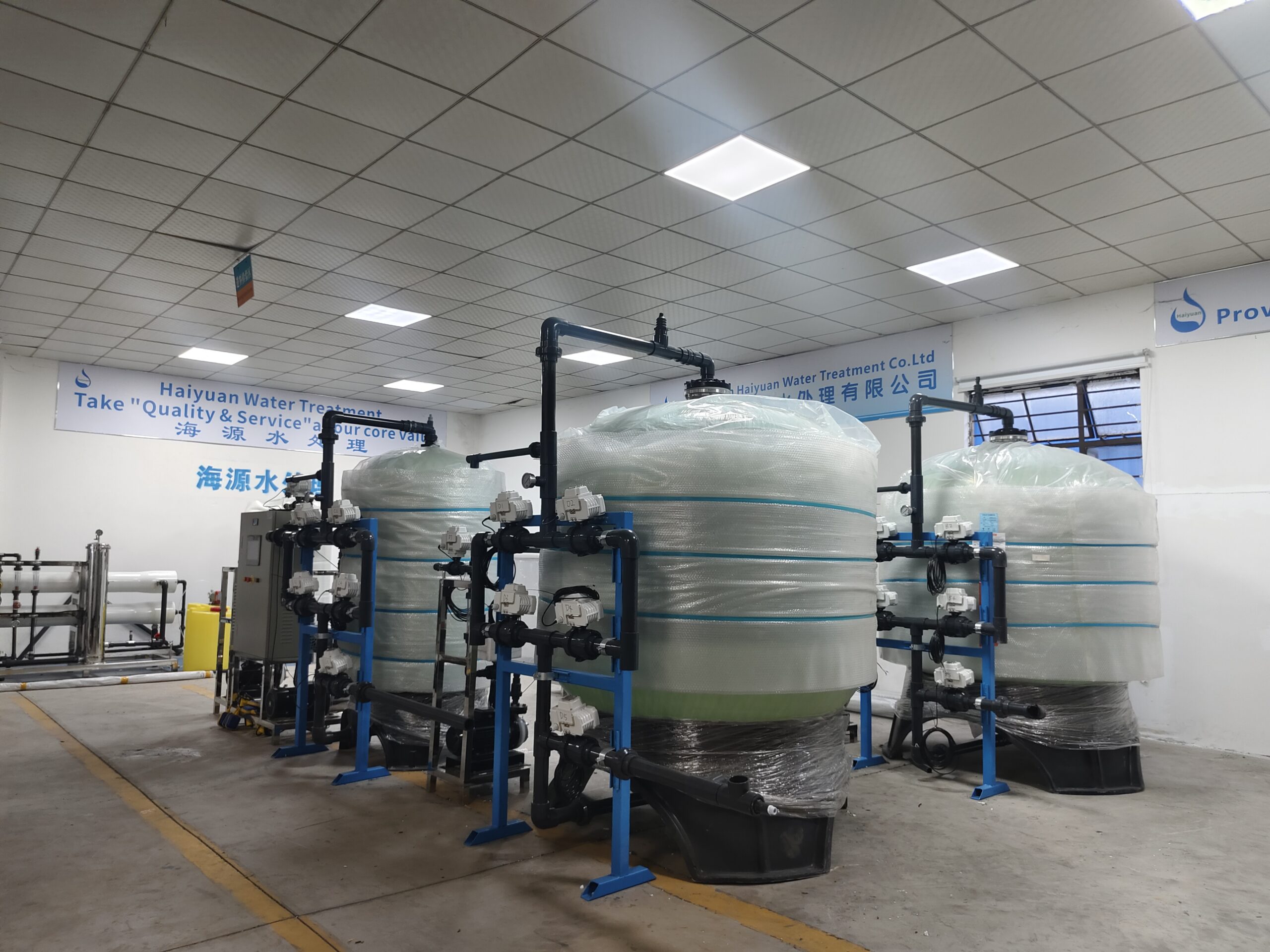
16.7 m³/h Double Bed + Mixed Bed Water Treatment System for Oman: An Efficient Solution for High-Salinity Water Purification
High-salinity water with high Total Dissolved Solids (TDS) has long been a key challenge for industrial and municipal water supply in the Middle East. Specifically, Oman is a typical arid region with little rainfall, so its water sources consistently have high TDS levels. Consequently, this places strict demands on the desalination efficiency, stability and adaptability of water treatment systems. To address this pressing need, the 16.7 Tonnes Per Hour (TPH) Dual Bed + Mixed Bed Water Treatment System has become a preferred choice for water purification in Oman, as it benefits from precise process design and localized parameter adaptation.
1. Project Background: Oman’s Water Quality Challenges and System Design Goals
Oman’s water bodies face two main challenges due to climate and geological factors. First, the TDS level stays stable at around 120 mg/L, so advanced desalination is therefore needed to meet water quality standards.
Against this backdrop, the 16.7 TPH Dual Bed + Mixed Bed System set two core goals at the design stage. Specifically, these goals focus on capacity matching and local adaptation:
Against this backdrop, the 16.7 TPH Dual Bed + Mixed Bed System set two core goals at the design stage:
- Match treatment capacity to actual needs: With a core parameter of 16.7 TPH, it directly meets the daily water demand of small-to-medium industrial plants and commercial complexes.
- 2. Adapt to local conditions in two aspects: On the water quality side, we specifically equip the system with advanced purification processes tailored for 120 mg/L TDS water. On the electrical side, meanwhile, the system strictly complies with the 415V/50Hz/3-Phase standard to effectively avoid equipment operational risks.
2. Core Technology: The “Dual Purification Logic” of Dual Bed + Mixed Bed
The system adopts a classic advanced purification process that combines “dual bed (cation exchange column + anion exchange column)” and “mixed bed”. Essentially, it achieves gradual water quality improvement through step-by-step treatment. Below is a detailed breakdown of the process and its key advantages:
2.1 Pre-Dual Bed: Preliminary Desalination and Impurity Removal:
The dual bed consists of a series-connected “cation exchange column” and “anion exchange column”, and it serves as the “pre-treatment core” of the system. Specifically, each component undertakes distinct purification tasks:
- Cation exchange column: It is filled with specialized cation resin. This resin prioritizes the adsorption of cations such as Ca²⁺, Mg²⁺, and Na⁺ from water, thereby reducing water hardness and partial salinity.
- Anion exchange column: It is equipped with strong-base anion resin. This resin specifically removes anions like Cl⁻, SO₄²⁻, and CO₃²⁻, thus initially lowering the TDS level to below 30 mg/L.
The main advantage of this staged design is that it minimizes resin contamination; furthermore, it extends service life and reduces the treatment load on the subsequent mixed bed.
2.2 Post-Mixed Bed: Advanced Refinement and Water Quality Compliance:
As the “precision treatment unit” of the system, the mixed bed is filled with a proportional mixture of cation and anion resins. This unique configuration enables “one-step ion exchange”:
Working principle: When water flows through the mixed bed, cation and anion resins simultaneously adsorb residual ions. In effect, this process is equivalent to “multiple dual bed treatments”. Ultimately, it stabilizes the TDS level at below 5 mg/L, which meets the standards for industrial process water (e.g., boiler feedwater, equipment cooling) and high-end domestic water use.
Core advantage: The treated water not only has stable quality and high purity but also the equipment occupies a small footprint. Moreover, this compact design makes it ideal for the compact factory layouts common in Oman.
3. Project Value: Multi-Dimensional Benefits from Water Purification to Cost Optimization:
The 16.7 TPH Dual Bed + Mixed Bed System not only solves Oman’s water quality issues but also creates long-term value for users in economic, environmental, and operational aspects. In detail, these benefits are reflected in the following three areas:
3.1 Economic Benefits: Reducing Water Costs and Consumable Consumption:
Compared to purchasing barreled purified water, the system’s operating cost is only 1/5 of that alternative. For instance, with an average daily operation of 12 hours, it saves over 100,000 Omani Rials in annual water costs. Moreover, the resins in the dual bed and mixed bed are recyclable through regeneration. Additionally, the regenerant dosage is only 80% of that of traditional systems, which further cuts consumable expenses.
3.2 Environmental Value: Minimizing Wastewater Discharge and Supporting Green Production:
The system achieves a water recovery rate of over 90%, which is far exceeding the industry average. This high recovery rate not only reduces freshwater intake but also minimizes wastewater discharge. Since there is no chemical residue, the regenerated wastewater can be reused for irrigation after simple treatment. Notably, this aligns perfectly with Oman’s environmental policies of “water conservation and emission reduction”.
3.3 Operational Advantages: Lowering Management Difficulty and Enhancing System Reliability:
The fully automatic PLC control system enables “one-click start/stop, fault alarm, and remote monitoring”, so maintenance personnel only need to conduct weekly inspections. Besides, core equipment components use internationally universal models, which are readily available for replacement locally in Oman. Consequently, this shortens maintenance cycles significantly.
4. Conclusion: A “Customized Purification Solution” Adapting to Local Needs:
Amid Oman’s high-salinity water conditions and unique electrical environment, the 16.7 TPH Dual Bed + Mixed Bed Water Treatment System successfully achieves the dual goals of “water quality compliance” and “efficient operation”. This system is more than just a water treatment device; instead, it is a “customized solution” tailored to the water quality characteristics of the Middle East.
In the future, such “localized” water treatment solutions will undoubtedly become the mainstream direction for water quality improvement in the Middle East. Furthermore, they will inject new impetus into water recycling and sustainable development in arid regions.
Contact Us
For more information about our Large Scale Water Purification Systems, customized solutions, or quotes, pleasecontact our professional team, We provide tailor-made solutions to meet vour water treatment needs
Contact Information
Email: eva@swroplant.com
Phone: +86 135 3283 6525